Your card is frequently the first thing they remember when they meet you at a business event, conference or client meeting. A nicely crafted card can make you look prepared and professional. It also makes it easy for folks to reach out to you later on.
Today there are many different Business Cards to pick from. Some still prefer traditional paper cards, others want digital or NFC solutions that operate with cellphones. Best depends on your profession, your industry, and the impression you want to make.
In this post, we will be looking at the top 10 types of Business Cards for professional networking. You’ll learn what each one is for, and who it’s best for.
Why Business Cards Still Matter for Networking
People often think that networking happens only on LinkedIn or email. Online networking is crucial, but there is still much to be said for building great professional ties face-to-face.
A card is a simple reminder to someone who you are . It also shows you were prepared.”
Good Business Cards can assist you:
- Quickly share your contact data.
- Make your brand more memorable.
- Have a discussion.
- Look more professional in meetings and events.
- Make it easy for individuals to follow up.
What sort of card you choose and the style of it says something about your business, so it is worth choosing carefully.
1. Standard Paper Business Cards
The basic paper card is the most typical option. It will typically contain your name, job title, company name, phone number, email and website.
Simple, inexpensive and easy to carry Business Cards. They are suitable for practically all industries.
Business Card Design with understandable text is more vital than adding too many graphics. If they can’t readily identify your phone number or email address, then the card has failed its function.
Best for:
- Small business owners
- Sales professionals
- Consultants
- Office workers
2. Premium Business Cards
Premium cards are thicker paper with finer finishing. Others have lifted writing, a soft-touch finish or foil detailing.
People feel more expensive when they have these Business Cards. These are good for a nice initial impression.
Many law firms, financial advisors and luxury corporations employ this style as it conveys quality.
Business Cards like these don’t need a busy design. The simplest layouts are frequently the most elegant.
Best for:
- Executives
- Luxury brands
- Financial services
- Real estate professionals
3. Minimalist Business Cards
Minimalist cards contain lots of white space and just the most important information.
This style has grown popular because of its clean and modern appeal. Your name and brand are the stars, not filling every nook and cranny.
A good Business Card Design doesn’t need to have loud colours or big logos. Less information sometimes makes for a better result.
Best for:
- Designers
- Architects
- Marketing professionals
- Creative agencies
4. Digital Business Cards
You can convey your details without having to hand out paper using the Digital Business Cards option. People will be able to open your profile in their phone and store your contact.
Digital Business Cards are being used by many professionals as they can be updated anytime. If your phone number or job title changes, you don’t have to print new cards.
Tapect provides intelligent digital profiles, making it simple to share your contact information during meetings and networking events.
These Business Cards are extremely beneficial for those who attend lots of conferences or meet clients a lot.
Best for:
- Entrepreneurs
- Startup founders
- Freelancers
- Sales teams
5. NFC Business Card
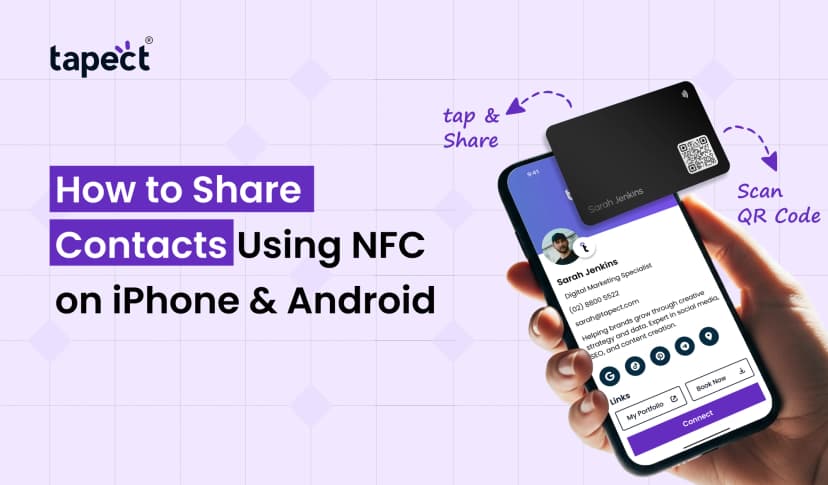
An nfc business card has a tiny chip built inside the card. Simply tap your smartphone against it and your contact page opens immediately.
An nfc business card is fast and current as there is no typing required. Most new mobile phones are NFC-enabled.
Tapect provides NFC cards that merge a physical card with a digital profile for effortless networking.
With a nfc business card you may publish your contact details, website, portfolio or social media connections within seconds.
Ideal for:
- Tech professionals
- Business owners
- Startup founders
- Sales representatives
6. QR Code Business Cards
QR code cards have a little square code that is scanned by the camera on people’s phones.
Your code can open your website, contact page, or digital profile. It adds a digital element to legacy cards. No NFC chips necessary.
These Business Cards are a nice middle ground between paper and technology.
Almost every smartphone can scan QR codes, so many Modern Business Cards have these on them.
Best for:
- Restaurants
- Event planners
- Coaches
- Small businesses
7. Metal Business Cards
Metal cards are special because they feel so different from paper.
They are durable and reusable and are generally retained longer than standard cards. They can be remembered by their weight alone.
These Business Cards cost extra and are frequently used when establishing an impression is more important than handing out a hundred cards.
Best for:
- CEOs
- Luxury brands
- Premium consultants
- High-end service providers
8. Folded Business Cards
Folded cards allow more space for information. They function like a little brochure.
You can include your services, a short company story, or even a map.
These Business Cards are excellent if you have multiple items or services that you cannot fit on one side of your card.
They’re a little bigger than regular cards but can provide the recipient with a little more value.
Best for:
- Travel agencies
- Insurance agents
- Restaurants
- Service businesses
9. Square Business Cards
Square cards are not the same as the normal rectangular shape.
The magnitude is remarkable and lodges in people’s minds. They are particularly good for creative firms.
Modern Business Cards often have square layouts, which are considered new and modern.
The main negative is that certain card holders are built for regular size cards.
Best for:
- Artists
- Photographers
- Fashion brands
- Creative studios
10. Eco-Friendly Business Cards
Eco-friendly cards are made from recycled paper or other sustainable resources.
More companies are selecting them because they care about the environment.
These Business Cards can still seem professional and show the ideals of a company.
Some companies also print fewer cards and pair them with digital sharing options to save waste.
Best suited for:
- Green businesses
- Nonprofits
- Organic brands
- Companies focused on sustainability
How to Choose the Right Type of Business Card
There is such a wide choice it can be hard to chose.
Ask yourself:
What industry am I in?
A lawyer might go for premium paper, and tech founder might opt for a nfc business card.
Who will receive the card?
If you’re dealing with corporate clientele, a clean professional design usually works best.
How often do I network?
If you attend events each month, Digital Business Cards can save you money on printing and time.
What is my budget?
The cheapest are the standard paper cards, with metal and NFC cards costing more.
The right card is about combining your networking demands to your style.
Business Card Printing Tips
Even the best design might appear ugly if it’s printed improperly.
Tips to consider while planning Business Card Printing:
- Use clear, easy-to-read fonts.
- Leave enough space around the text.
- Check spelling and contact details carefully.
- Use high-quality paper if possible.
- Ask for a proof before printing a large order.
Good business card printing makes your card look clean and professional.
What Makes a Great Business Card Design?
A decent Business Card Design must be able to answer 3 questions in only a few seconds:
- Who are you?
- What do you do?
- How can someone contact you?
If those answers are clear, that’s what the card is doing.
Avoid adding too much text. Learn more on our website. The card should make it easy for someone to remember you and to contact you.
FAQs
1. What kind of business card is ideal for networking?
It is dependent on the industry you work in what option is ideal for you. While most professionals use standard paper cards, NFC and digital cards are excellent options for consumers who desire fast contact sharing.
2. Are digital business cards superior to physical ones?
Digital Business Cards can be updated more easily and provide more information. Many individuals use both, because paper cards still perform effectively in face-to-face meetings.
3. Should I have an NFC Business Card?
An nfc business card is useful if you do a lot of networking and you want to give your contact details with a quick tap.
4. What does a business card have to contain?
Add your Name, Company, Job Title, Phone Number, Email, Website and a QR Code if you use one.
5. How many business cards should I order?
If you attend events regularly, begin with a few hundred. If you have a digital option you may need less printed cards.
Conclusion
The best Business Cards can make networking easier, and help people remember you after a meeting. From traditional paper cards to premium, QR code and NFC choices, there are benefits to any form.
Think about your industry, your audience and how often you encounter new individuals. A simple card with a clear message is typically more effective than a card that is full of too much information.
Tapect provides clever digital and NFC solutions to link your physical card to an easy-to-share digital profile for professionals who desire a modern method to network. This keeps the personal card feel but makes it simple for new contacts to save your details.
Call to Action
Want to level up your networking? Find out more about Tapect’s digital and NFC business card solutions to make a professional card that is easy to share, easy to update and built for modern business interactions. Make a memorable first impression with a card that allows people to remember you and contact you with one tap.
 8/21/2026
 business